Stop debugging solvers.
Start engineering.
IteraSim builds AI that runs computational fluid dynamics end to end — case setup, meshing, solving, and the 3 a.m. divergence that eats your afternoon. Grounded in OpenFOAM, built at ETH Zürich, running on your own machine.
Free tier forever · No credit card · Linux & Windows
CFD's bottleneck was never compute.
Every plane, reactor, chip and pump is designed with computational fluid dynamics. Yet engineers spend most of a project on setup, debugging and documentation — not engineering. The commercial suites cost tens of thousands per seat. OpenFOAM is free and takes six months to learn.
Setup is archaeology
Physics described in a directory of cryptic text dictionaries. One wrong keyword in fvSchemes and nothing tells you until hour three of a run.
Failure is silent
The solver dies with a floating-point exception and no explanation. You read a log, guess a scheme, re-run, lose a day. Then do it again.
General AI can't help
It can't see your mesh, your boundary conditions or your solver logs. A diverging case is a physics problem, not a syntax error.
Three ways in, one domain model underneath.
All of it is grounded in the same thing: a retrieval system built over OpenFOAM's own source and documentation, plus a CFD knowledge base encoding six years of real solver failures and their fixes.
Eddy — the desktop agent
Reads your entire OpenFOAM case, builds it, meshes it, runs it. When the solver diverges it diagnoses the cause, patches the dictionary and re-runs — unattended. Runs locally; your geometry never leaves your network.
Explore EddyIteraSim AI assistant
Ask OpenFOAM questions in the browser and get answers grounded in the documentation rather than guesswork — turbulence models, boundary conditions, scheme selection, log diagnosis.
Launch the assistantWorkshops & training
Forty hours of curriculum on OpenFOAM and CFD–machine-learning integration, delivered internationally to engineers who use it the next day. We taught this before we automated it.
See the programmePowered by real OpenFOAM physics.
Not renders. These are solved fields — turbulent airfoil flow, snappyHexMesh on real geometry, and multiphase pipe dynamics.
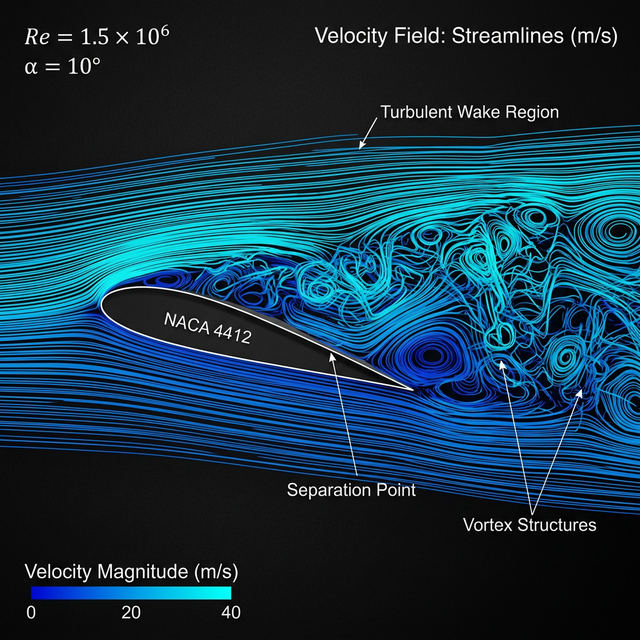
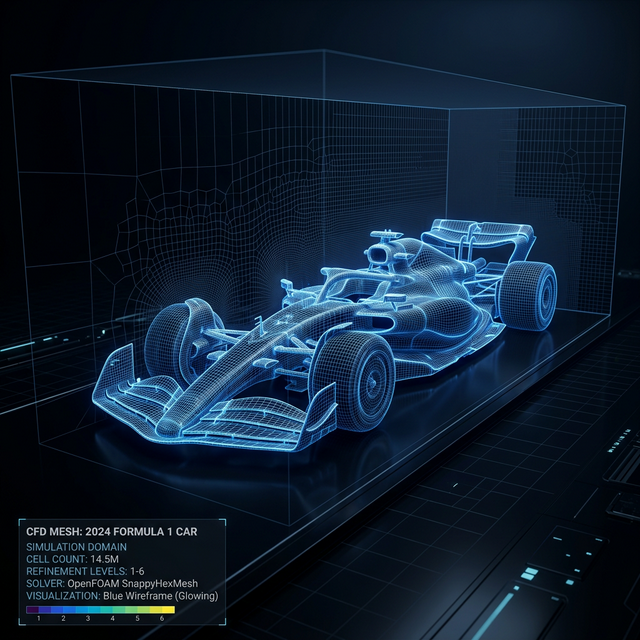
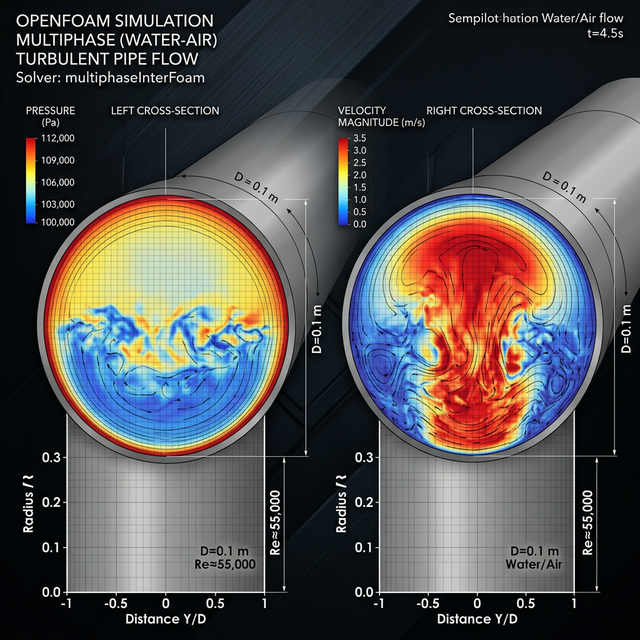
From a folder to a converged result.
Eddy drives the real OpenFOAM pipeline through a real shell. Nothing is mocked — it runs the same commands you would, and shows you every one of them.
Point it at a case
Any folder with system/, constant/ and 0/ is recognised instantly — or start from an STL and let the builder write the dictionaries.
Describe the physics
"Set up a Boussinesq buoyant case with air at 300 K." Every file change is previewed before a byte is written.
Run the pipeline
blockMesh, snappyHexMesh or Gmsh, then checkMesh, decomposePar, mpirun. Locally on your cores, or submitted to your Slurm cluster.
It fixes what breaks
On divergence it reads the log, names the numerical cause, patches the dictionary and re-runs — with a full history you can revert file by file.
Wherever a flow decides the design.
Aerodynamics
External flow, drag and lift, wind loading — RANS, LES and DES on real CAD geometry.
Multiphase & thermal
Boiling, condensation, free surfaces, conjugate heat transfer and buoyancy-driven convection.
Process engineering
Mixers, reactors, pipe networks, porous media and particle-laden flow in plant equipment.
Energy & nuclear
Thermal-hydraulics, breeder-blanket and coolant-loop studies on air-gapped infrastructure.
Checked against physics with a published answer.
An agent that confidently produces a wrong flow field is worse than no agent. So it's validated against benchmarks whose answers are already in the literature — and against the failure modes notorious for diverging quietly.
Lid-driven cavity, Re = 1000
Reproduces Ghia, Ghia & Shin (1982) along the vertical centreline to well under one percent, with the primary vortex near (0.53, 0.56).
buoyantSimpleFoam, Boussinesq
A configuration notorious for silently diverging. Eddy diagnoses the crash, repairs the case and completes the run with no human in the loop.
Peer-reviewed foundations
Four OpenFOAM solvers written from scratch in C++. Published in Physics of Fluids; an earlier paper took the front cover of ACS Industrial & Engineering Chemistry Research.
We taught this before we automated it.
An international workshop series on OpenFOAM and CFD–machine-learning integration, delivered to engineers and researchers who use it the next day. The product exists because the same questions kept coming up — and almost none of them were about physics.
Let the agent run the simulation.
Download Eddy, point it at a case you already have, and ask what the case actually does. That first answer takes about thirty seconds.
Free forever on the Local tier · Linux & Windows · info@iterasim.in